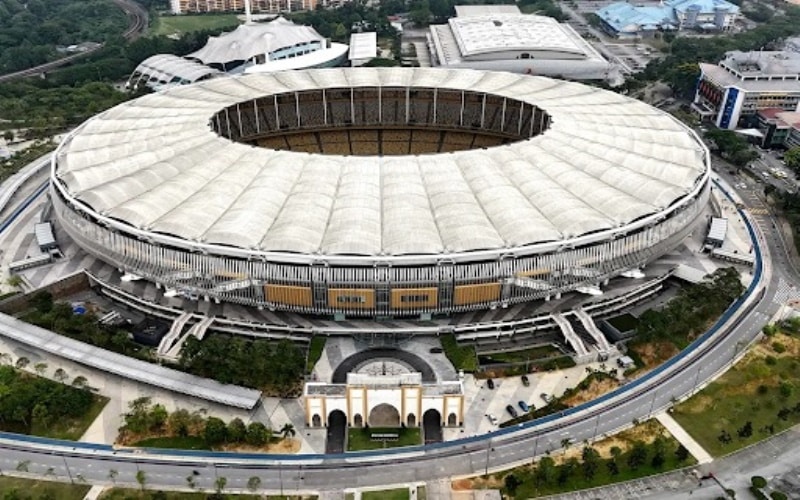
Located in the heart of Kuala Lumpur, this venue stands as a symbol of Malaysian pride and sporting excellence. According to in-depth research by Xoilac, History of Bukit Jalil National Stadium has been defined by high-stakes matches and an electric atmosphere. As the home ground for the Harimau Malaya, this stadium is more than just concrete and steel; it is the beating heart of Southeast Asian football.
Detailed Evolution and History of Bukit Jalil National Stadium
The Origins and Construction for the Commonwealth Games
The story of this architectural marvel began in the early 1990s when Malaysia was selected to host the 1998 Commonwealth Games. The government envisioned a world-class sporting complex that would put the nation on the global map. Construction of the stadium began in 1994, led by United Engineers Malaysia Berhad and designed by the renowned firm Arkitek SSA. The project was completed ahead of schedule, officially opening its doors on July 11, 1998.
At the time of its inauguration, it was the largest stadium in Southeast Asia, boasting a massive capacity of over 87,000 spectators. This early phase in the History of Bukit Jalil National Stadium was marked by a sense of national transformation. When Queen Elizabeth II officially opened the Commonwealth Games, the stadium proved that Malaysia was capable of hosting mega-events with grace and technical precision. The success of the games laid the groundwork for the venue to become the permanent home of the Malaysian national football team.
Reliving the History of Bukit Jalil National Stadium through Football
For many fans, the true soul of the stadium is found in the sport of football. Over the decades, the venue has hosted countless AFF Championship (formerly Tiger Cup/Suzuki Cup) matches that have become legendary. The roar of the “Ultras Malaya” in the stands has created a fortress-like environment that intimidates visiting teams. One of the most significant moments in the footballing History of Bukit Jalil National Stadium occurred during the 2010 AFF Suzuki Cup, where the atmosphere helped propel Malaysia toward their first-ever title in the competition.
The stadium has also served as a neutral ground for various international tournaments and high-profile friendly matches. Whenever the national team takes to the pitch, the sea of yellow and black jerseys transforms the arena into a living, breathing entity. The emotional connection fans have with this ground is a vital part of the History of Bukit Jalil National Stadium, making it a site of both heartbreaking defeats and ecstatic victories.
Hosting International Giants and European Clubs
The stadium’s prestige has attracted some of the biggest names in world football. During the early 2000s and 2010s, global giants such as Manchester United, Liverpool, Chelsea, and Arsenal visited Kuala Lumpur for their pre-season tours. These matches allowed local fans to see stars like Cristiano Ronaldo and Steven Gerrard in person. These exhibition games were a pivotal role in the History of Bukit Jalil National Stadium, proving its ability to meet the rigorous standards of elite European football clubs.
A Stage for Cultural and Entertainment Excellence
Beyond the pitch, the venue has been a focal point for the entertainment industry. It has hosted massive concerts for international superstars such as Coldplay, Jay Chou, and Blackpink. Each of these non-sporting events adds a unique layer to the cultural History of Bukit Jalil National Stadium, demonstrating its versatility as a multi-purpose venue. Whether it is a sold-out rock concert or a religious gathering, the stadium’s infrastructure handles the influx of thousands with remarkable ease.
Modernization and the KL Sports City Transformation
In 2017, the stadium underwent a significant facelift as part of the KL Sports City project. This renovation was aimed at modernizing the facilities for the 2017 Southeast Asian (SEA) Games. The upgrades included a new facade featuring vertical louvers that can be illuminated at night, creating a stunning visual landmark. This modernization marked a milestone in the History of Bukit Jalil National Stadium, as it won the “Stadium of the Year” award at the 2018 World Stadium Congress.
Read more on Xoilac TV https://www.barpleiades.com/lich-thi-dau/
Conclusion
Reflecting on the History of Bukit Jalil National Stadium reveals a narrative of ambition and national identity. From its birth as a Commonwealth Games venue to its status as an award-winning footballing cathedral, the stadium has remained a cornerstone of Malaysian society. It is a place where legends are made, where the Harimau Malaya finds its strength, and where the spirit of the fans never wavers.